Shot Tracking vs Launch Monitor: Which Helps Your Game More?
Evidence: Research-led. This guide uses current product information and practical category analysis. It is not based on hands-on testing of every shot-tracking system or launch monitor mentioned.
If you are trying to improve rather than simply buy another golf gadget, shot tracking and a launch monitor solve different problems. One helps you see what happened on the course. The other helps you understand what happened at impact.
That distinction matters. A golfer who regularly loses strokes through poor club selection, penalty shots or weak approaches may learn more from a season of on-course data than from another session staring at carry distance. A golfer whose practice never translates because they do not know whether strike, launch or face delivery is changing may get more value from a launch monitor.
The practical answer is not that one is universally better. It is about choosing the feedback loop you will genuinely use.
What is the difference?
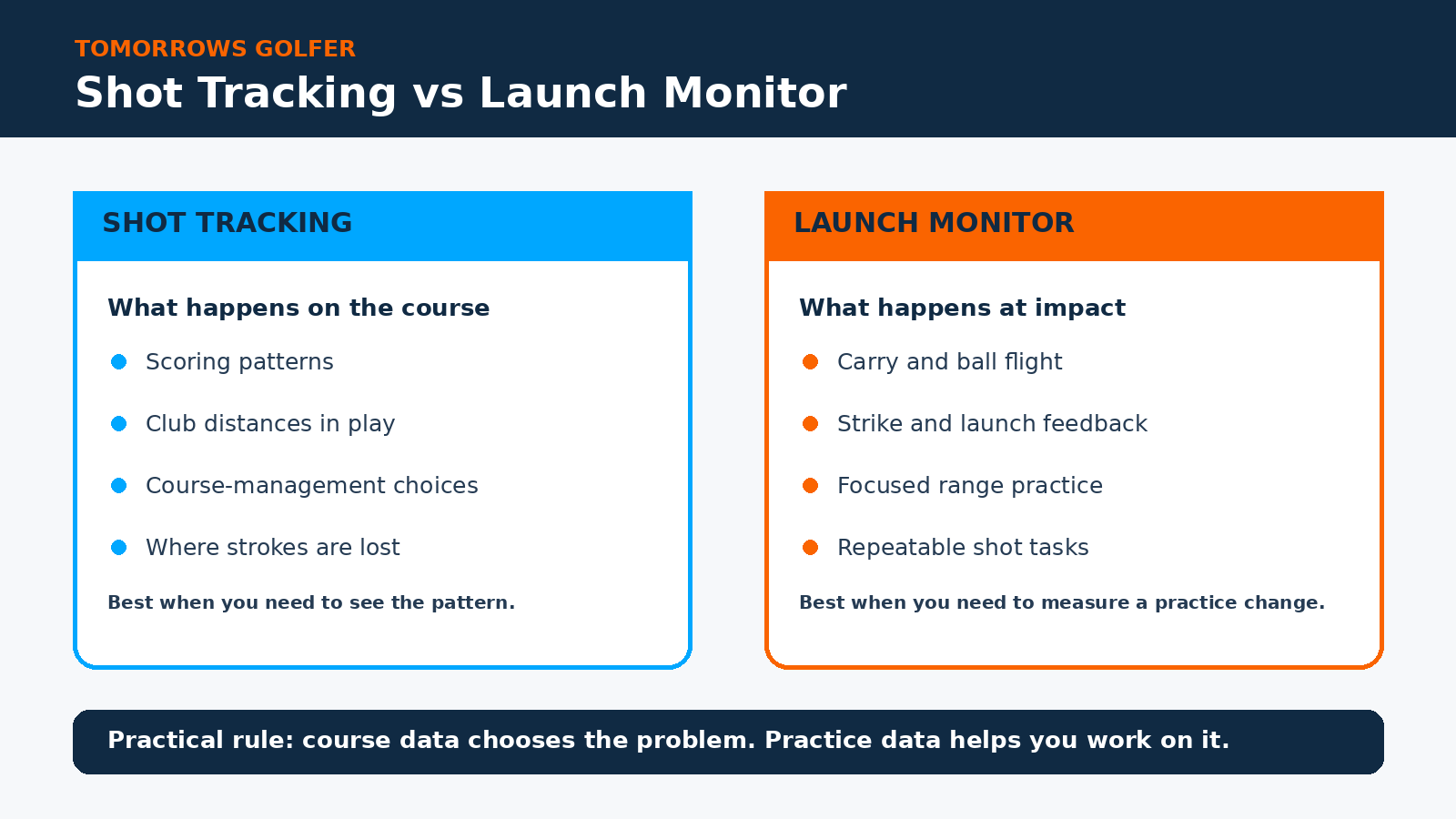
Shot tracking records what happens during rounds: where shots finish, how far clubs travel in real play, scoring patterns and, depending on the system, strokes-gained style categories. Systems such as Arccos describe this as automatic on-course shot capture and post-round analysis.
A launch monitor measures the shot itself. Depending on the device and setup, that can include ball speed, launch angle, carry distance, direction, spin-related information or club delivery data. The useful bit for an everyday golfer is not collecting every number. It is using a small number of reliable measures to make practice more deliberate. Our guide to using launch-monitor data at the range explains how to keep that process simple.
In short: shot tracking is a course-management and performance-pattern tool. A launch monitor is a ball-flight and practice-feedback tool.
Choose shot tracking if your biggest questions happen on the course
Best for: golfers who want to understand where scores are leaking away
Shot tracking is the stronger first purchase when the question is, “Why am I not scoring better?” rather than, “What is my club speed?” A normal scorecard cannot tell you whether the real issue is approach proximity, tee-shot penalties, poor recovery choices or too many three-putts. Round-by-round shot data can.
It is especially useful if you tend to make vague post-round judgements. “I drove it badly” might turn out to mean two costly penalty shots. “My irons were awful” might actually be a distance-control issue from 120 to 150 yards. That is the kind of pattern a tracker can help surface over several rounds.
The trade-off: it needs complete, honest use over time
Shot tracking becomes useful through a run of representative rounds, not one exceptional Saturday. You need to review the data, trust the captured shots and avoid turning every dashboard into a verdict on your swing. It also will not tell you exactly why a particular shot launched too low or curved right. It shows the outcome, not the impact mechanics.
Choose a launch monitor if your biggest questions happen at practice
Best for: golfers who want clearer feedback on a repeatable practice task
A launch monitor makes most sense when you can name the practice question. For example: is a swing change improving strike and carry consistency? Is the 7-iron going its expected distance? Does a lower-flight shot actually fly lower? Those are measurable questions.
It can also be a good fit for golfers who use a driving range regularly, practise at home or are deciding whether a more permanent setup is worthwhile. If that last point is you, start with our practical comparison of a launch monitor versus a golf simulator, then check what accuracy really means before comparing models.
The trade-off: numbers do not automatically create a practice plan
A launch monitor can produce far more information than a mid-handicap golfer needs. It is easy to chase a perfect ball-speed number, compare sessions with different balls or conditions, and leave without a useful next step. The better approach is to pick one outcome measure and one possible cause, then hit a sensible sample of shots.
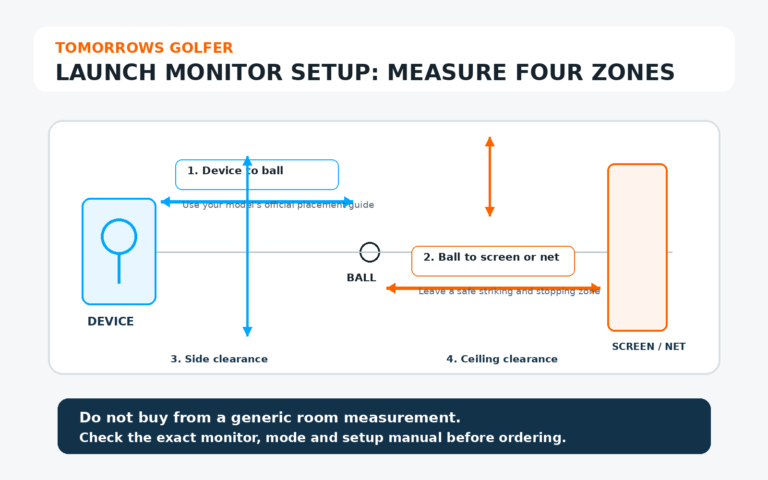
Outdoor and indoor use can also change the practical experience. Device placement, available ball flight and the ball itself can matter, so check the manufacturer guidance for any model you are considering. Our article on using a launch monitor outdoors covers the setup questions worth asking before you buy.
When owning both makes sense
The two tools complement each other when you have a clear workflow. Shot tracking identifies a problem from real golf. A launch monitor gives you a controlled way to practise a possible solution. Then the course tells you whether that work travelled.
Say your tracking shows weak results on approaches from a particular distance band. The answer is not automatically more swing data. First check course-management choices, lie quality and how often the situation actually occurs. If the pattern remains, use a launch monitor at the range to build a tighter carry-distance window with the relevant clubs. That is a useful loop.
Buying both at once is usually unnecessary. Start with the tool closest to your current bottleneck, then add the other only when you can explain what it would change.
A simple decision rule
Pick shot tracking first when:
- Your main goal is lower scores and better course decisions.
- You play enough full rounds to build a meaningful sample.
- You are unsure which part of your game actually costs the most shots.
- You want club-distance information from normal playing conditions.
Pick a launch monitor first when:
- You practise regularly and need feedback beyond “that felt good”.
- You are working on carry distance, strike quality, start direction or a repeatable shot shape.
- You will use it at the range or in a realistic home-practice setup.
- You can keep your practice focused on a few useful numbers.
Who should skip both for now?
Skip the purchase if the technology would replace rather than improve your golfing routine. A golfer who rarely plays, seldom practises and does not review their rounds is unlikely to get lasting value from either category. A few lessons, regular course time or a structured range habit may be the better first spend.
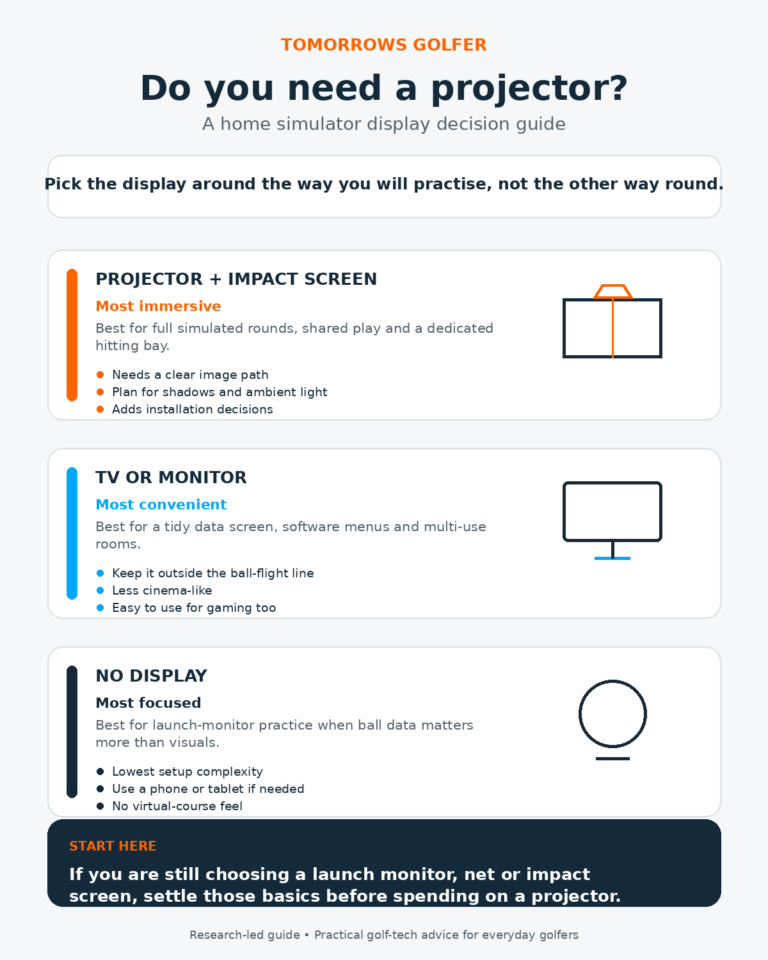
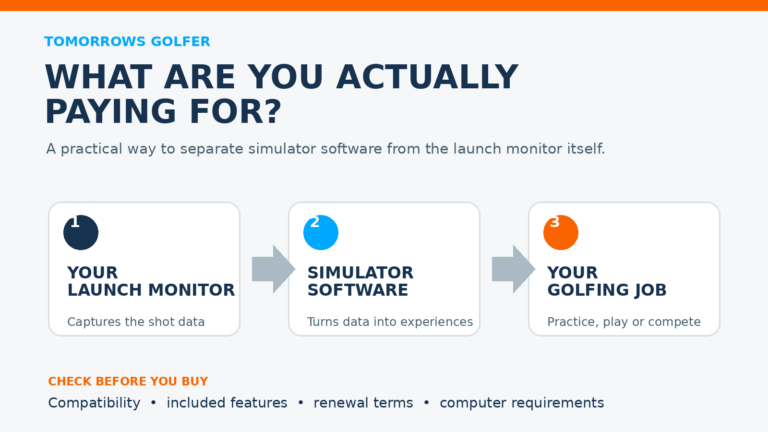
Also be cautious of buying a launch monitor purely because a simulator looks appealing. A simulator setup has separate space, display, mat, net or screen and software considerations. Read our UK simulator-cost guide before treating the monitor as the whole budget.
Tomorrows Golfer verdict
Shot tracking helps you choose what to improve. A launch monitor helps you practise how to improve it.
For a golfer whose scores feel inconsistent or mysterious, shot tracking is often the more revealing starting point because it follows real golf. For a golfer with a steady practice habit and a specific ball-flight question, a launch monitor is likely to be more immediately useful. The best choice is the one that fits your next 20 rounds or range sessions, not the one with the longest spec sheet.