Golf Hitting Mat vs Hitting Strip: What Should You Buy?
Evidence label: Research-led guide. This article is based on product-category design, current seller setup information and practical home-practice considerations. Tomorrows Golfer has not hands-on tested every mat or strip mentioned by the category.
A full golf hitting mat and a hitting strip can both make home practice more practical. They are not simply bigger and smaller versions of the same purchase, though. The choice changes how portable the setup is, how much space it takes up, what happens when the hitting area wears, and whether it makes sense in a future simulator bay.
Quick verdict
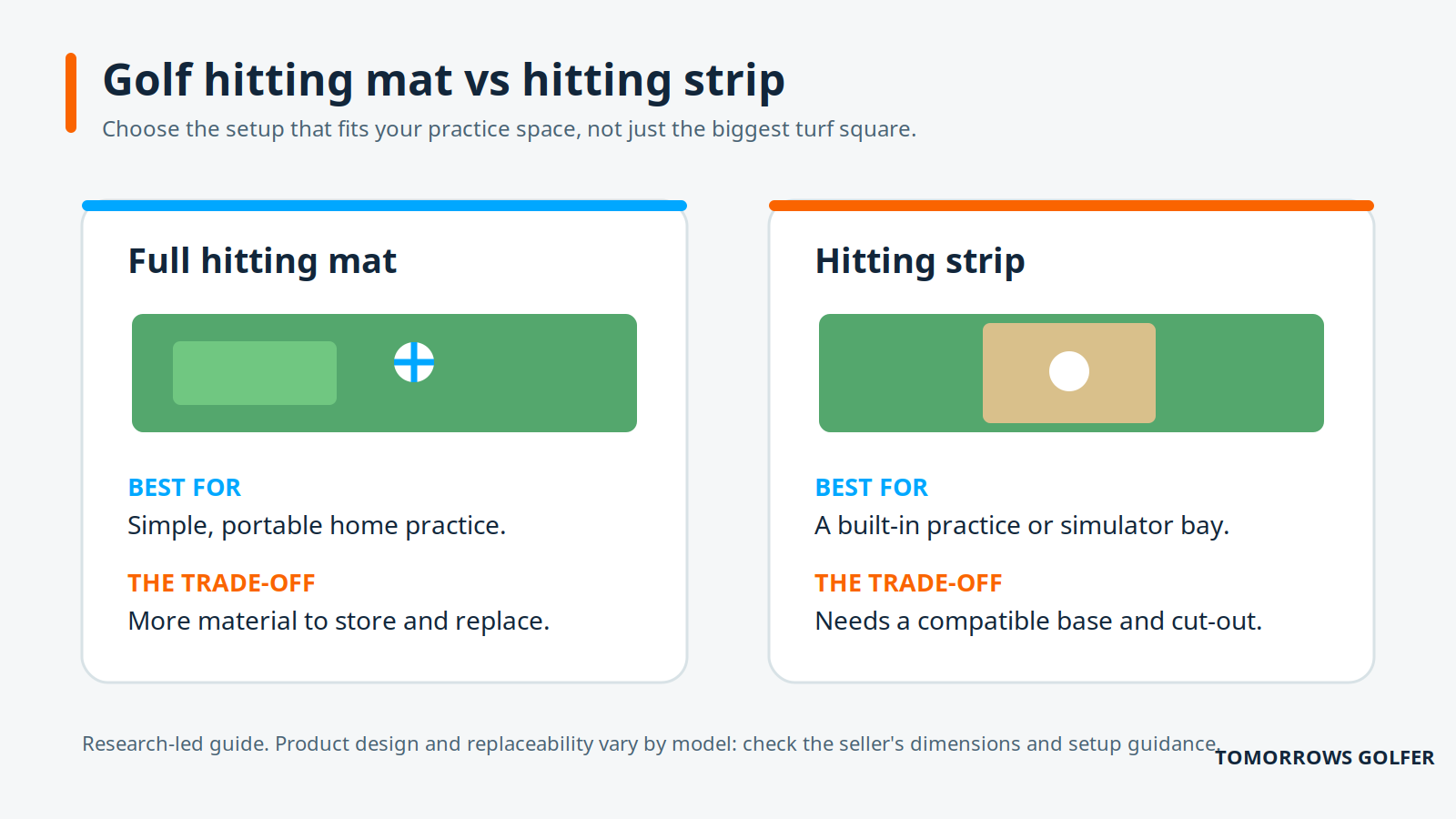
Buy a full hitting mat if you want a straightforward, moveable practice surface for a garage, garden or occasional net session. It is usually the lower-friction option because the turf and hitting area arrive as one piece.
Choose a hitting strip if you are building a more permanent practice or simulator bay and want the impact area to be a separate, potentially replaceable part of the floor. It can be the smarter long-term layout, but only when the base, cut-out depth and surrounding turf are planned together.
What is the practical difference?
A full hitting mat is a complete portable surface. You place it in front of a net or screen, set the ball on its hitting area and pack it away when you are finished. Some mats include several turf textures or tee positions. Others are deliberately simple. The important point is that the hitting surface is built into the mat.
A hitting strip is a narrower impact section installed into a compatible base or a cut-out in surrounding turf. Think of it as the part designed to take repeated shots, rather than the whole floor. That makes it attractive in a fixed setup, but it is not automatically a better mat. A strip still needs the right height, secure fit and enough surrounding surface to stand comfortably.
Choose a full hitting mat if portability matters most
A full mat is the sensible default for golfers who practise in a shared space. You can put it down for an hour, align it with a net, then store it without rebuilding the room. That simplicity matters more than it sounds. A practice setup that takes ten minutes to assemble often gets used less than one that is ready to go.
It is also a good fit when your budget is focused on getting a safe, usable hitting area before adding a launch monitor, projector or premium enclosure. Our guide to golf simulator costs in the UK explains why it is worth separating the essential practice kit from the upgrades that can wait.
The trade-off is wear. Once a one-piece mat’s main hitting zone is tired, the practical replacement decision may involve the whole mat. Before buying, check whether the seller states a replaceable insert, a defined hitting zone or any restriction on real tees. Do not assume one mat’s design applies to another.
Choose a hitting strip if you are planning a fixed bay
A strip makes most sense when the practice area has a home. That could be a simulator enclosure, a garage bay or a dedicated room where the floor layout is unlikely to move. It lets you place the impact area exactly where the golfer stands and where the monitor expects the ball to be.
That can make future maintenance less wasteful, provided the seller actually offers replacement strips and the dimensions remain compatible. It can also help you make the finished floor feel more intentional, rather than placing a loose mat on top of carpet or concrete.
The catch is installation. A strip needs a compatible base, surround or recess. Measure the overall height as well as the length and width. A raised hitting surface can affect ball position, stance and the available ceiling clearance. If you are building indoors, use our golf simulator room-size guide before committing to a floor design.
Do not buy on “realistic turf” language alone
Marketing descriptions can make every surface sound like a fairway. A better buying question is: will this setup make practice easy and repeatable without creating a new problem?
- For a garden or temporary garage setup: prioritise stability, portability and a footprint you can genuinely live with.
- For repeated iron practice: check how the hitting zone is constructed and whether it can be replaced. Avoid treating a broad warranty claim as proof that the mat suits your swing or usage.
- For a simulator build: check finished height, cut-out requirements and where the ball will sit relative to the launch monitor.
- For a net setup: make safety and room depth the first decision, then choose the turf. A premium mat does not compensate for an unsafe ball-stopping setup.
How the choice affects launch-monitor practice
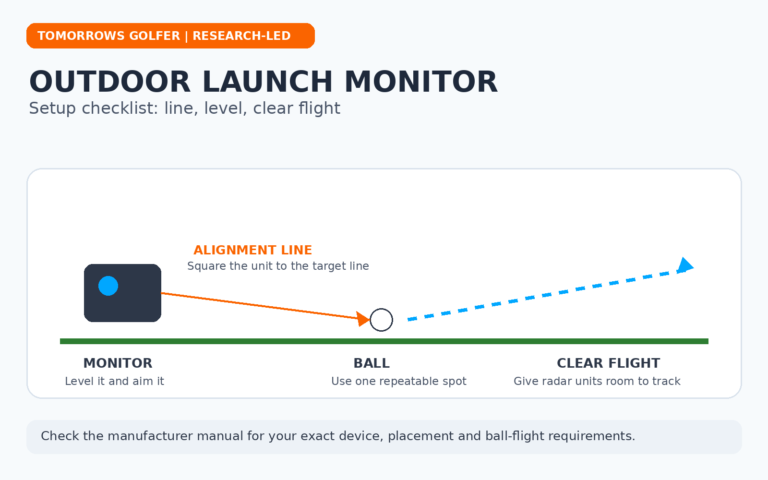
Mat choice does not change a monitor’s technology, but it can change the conditions around the shot. A mat that shifts, puts the ball at an unexpected height or forces you to hit from a different place each session makes comparison harder. That matters if you use a monitor to compare carry distances or test a swing change.
Keep the ball position and monitor placement consistent. For more on making sense of the readings, see how to use launch-monitor data at the range without overthinking it and our plain-English guide to launch-monitor accuracy.
Questions to ask before ordering
- What are the exact width, length and finished height?
- Can the main hitting area be replaced, and is the replacement currently sold?
- Does a strip need a specific base, frame or cut-out?
- Will the ball height work with your net, screen and launch monitor setup?
- Where will the mat live between sessions?
Who this is for
Golfers setting up a home net, a garage practice station or an entry-level simulator area who want to spend sensibly on the part they will stand on for every shot.
Who should skip it
Golfers who are still unsure whether they have enough room to hit safely. Sort out the room, ceiling and ball-stopping plan first. Our guide to golf simulator nets versus impact screens is the better starting point for that decision.
Final verdict
A full hitting mat is usually the practical buy for flexible home practice. A hitting strip earns its extra planning only when you are building a fixed space and value a separate, serviceable impact area. Measure the whole setup, not just the turf, and verify the current replacement and installation details before you pay.