Golf GPS Watch vs Handheld GPS: Which Is Better on the Course?
Evidence: Research-led comparison. This guide is based on current manufacturer product information and practical buying analysis. It is not a hands-on test.
A golf GPS watch is the easier choice if you want a yardage tool that is already on your wrist. A handheld GPS makes more sense if you value a larger screen and are happy to take a device out of your pocket, bag or trolley.
That sounds obvious, but it is the decision that stops many golfers buying the wrong format. The better option is not necessarily the one with the longer feature list. It is the one you will actually use before most shots.
The short answer
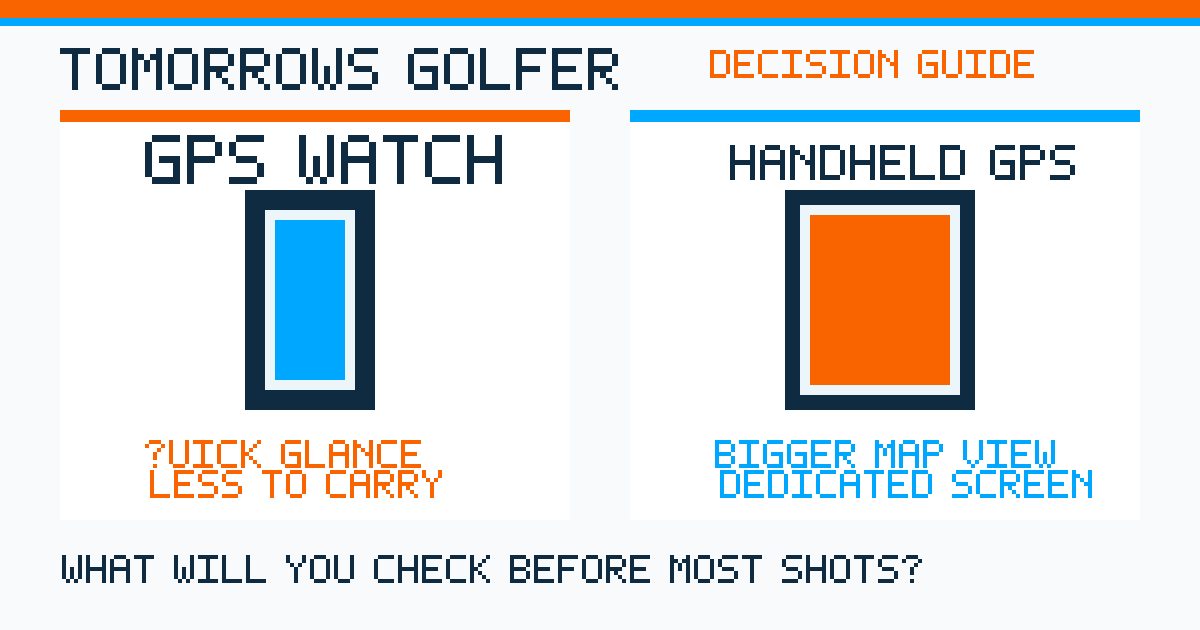
- Choose a golf GPS watch if quick, hands-free yardages matter most and you also want a watch away from the course.
- Choose a handheld GPS if you prefer a bigger map view, clearer touch targets and a dedicated golf device.
- Skip both for now if you mainly need exact pin distances. A laser rangefinder may suit that job better, although it does not replace GPS hazard and front/middle/back information.
For the broader distance-measuring decision, see our GPS vs laser rangefinder guide. If your real alternative is your phone, our golf GPS watch vs phone app comparison is the more useful next read.
What changes when the GPS is on your wrist?
The watch format wins on friction. You raise your wrist, glance at the number and get on with the shot. There is no device to retrieve, no need to find a place to put it down and less chance of leaving it on a buggy seat.
That matters most for golfers who play quickly, walk regularly or do not want another item clipped to a bag. A watch can also make front, middle and back distances feel more natural to use than a phone, because the information is always in the same place.
The trade-off is screen space. A watch can show the essentials very well, but a small display asks you to be selective. If you want to inspect a whole hole, move a target around a green or study hazards in detail, a watch is rarely the most relaxed way to do it.
Current products underline the format difference. Garmin describes the Approach S50 as a GPS golf watch with an AMOLED display, on-course features and wellness tracking. That combination is attractive when golf is only one part of how you plan to use the device. It is not, by itself, a reason to pay for features you will never open.
Why a handheld can still be the better golf tool
A handheld GPS is more deliberate. You need to reach for it, but you get a screen designed around the golf information rather than a wearable form factor. For many players, that makes full-hole views and hazard layouts easier to read before a tee shot or lay-up.
It can be a good fit for a trolley golfer, a player who likes to plan the hole before walking off the tee, or anyone who finds small touch controls fiddly. It can also be the simpler choice if you do not want notifications and fitness functions sharing the same device as your course information.
There is a useful split even within handhelds. Garmin positions the Approach G20 Solar as a GPS golf handheld, while its Approach G80 is a colour touchscreen handheld with an integrated launch monitor. That does not make one universally better. It shows why you should compare the job you need done, rather than shopping only by device category.
Watch vs handheld: the practical trade-offs
Glanceability
Watch advantage. A wrist check is hard to beat for a quick number before a normal approach. If you tend to use GPS mainly for front, middle and back distances, this is the strongest argument for a watch.
Map detail and planning
Handheld advantage. A larger display gives more room for a hole layout, hazards and target selection. It is especially helpful if you often play unfamiliar courses or make considered lay-up decisions.
Convenience while walking
Watch advantage. Nothing needs carrying or putting back. A handheld is still easy enough with a clip or trolley mount, but it adds one more small routine to every shot.
Battery management
Neither wins automatically. Published battery claims vary by model and mode, so check the current manufacturer specification for the exact device. Think about your typical round, whether you play more than once before charging, and whether you also want the device for everyday wear.
Value
It depends on overlap. A watch can represent better value when you genuinely want its non-golf functions. A handheld can be the more disciplined purchase if all you need is a dedicated golf screen. Do not assume a higher price means better course decisions.
Who should buy a golf GPS watch?
A watch is the sensible option for the everyday golfer who wants unobtrusive distances and will use it on most rounds. It is particularly strong if:
- you walk the course and want less kit in your hands;
- you mostly need quick yardages rather than detailed maps;
- you want a wearable for both golf and daily life;
- you dislike taking a phone out during a round.
Who should skip it: golfers who struggle to read small screens, want a full-hole view before every decision, or prefer a dedicated device that stays on a trolley or bag.
Who should buy a handheld GPS?
A handheld is the better fit for golfers who treat GPS as a planning tool, rather than a quick reference. It is worth a close look if:
- you value a larger map and clearer controls;
- you play unfamiliar courses often;
- you use a trolley or buggy and have an obvious place for the device;
- you want golf information without an everyday smartwatch.
Who should skip it: golfers who know they will leave it in a pocket, forget to charge it or only ever check a simple number. In that case, the extra screen may not make you any more decisive.
Three checks before you buy either format
- Check your home courses. Look at the manufacturer’s course-coverage information and make sure the courses you play are supported. Course mapping and feature availability can change, so verify this before buying.
- Check the exact subscription and update terms. Do not assume that every mapping, scoring or statistics feature is included forever. The product page and current support documentation are the right places to confirm this.
- Try the screen size in real conditions. Product photos make every display look generous. Think about bright sun, rain gloves, reading glasses and how often you need more than a front, middle and back number.
Tomorrows Golfer verdict
For most golfers, a GPS watch is the better everyday buy because it removes the small hassle that stops people using a device consistently. A handheld is the smarter specialist choice when a bigger course view will genuinely improve your decisions.
Do not buy a handheld because it looks more serious, and do not buy a watch simply because it has more lifestyle features. Choose the format that lets you check the information quickly, trust it and keep your attention on the shot.