Golf GPS Watch Battery Life: What GPS Mode Really Means for a Round
Evidence: Research-led guide. This article uses manufacturer product information and practical buying considerations. It is not a hands-on battery test, and quoted runtimes should not be treated as a promise for every round.
A golf GPS watch can look as though it has plenty of charge at breakfast and still leave you watching the battery icon by the 16th. The usual reason is simple: the number on the box may describe ordinary smartwatch use, while a round asks the watch to keep GPS active, wake its screen repeatedly and sometimes handle scoring, notifications and other features at the same time.
That does not mean a golf watch is unreliable. It means the useful question is not “how many days does it last?” It is “what does the manufacturer mean by golf or GPS mode, and does that comfortably cover my longest normal day?”
Start with the golf or GPS figure, not the smartwatch figure
Manufacturers commonly publish more than one battery estimate for the same watch. The everyday smartwatch number may assume a very different mix of screen use, connected features and location tracking from a four-hour round.
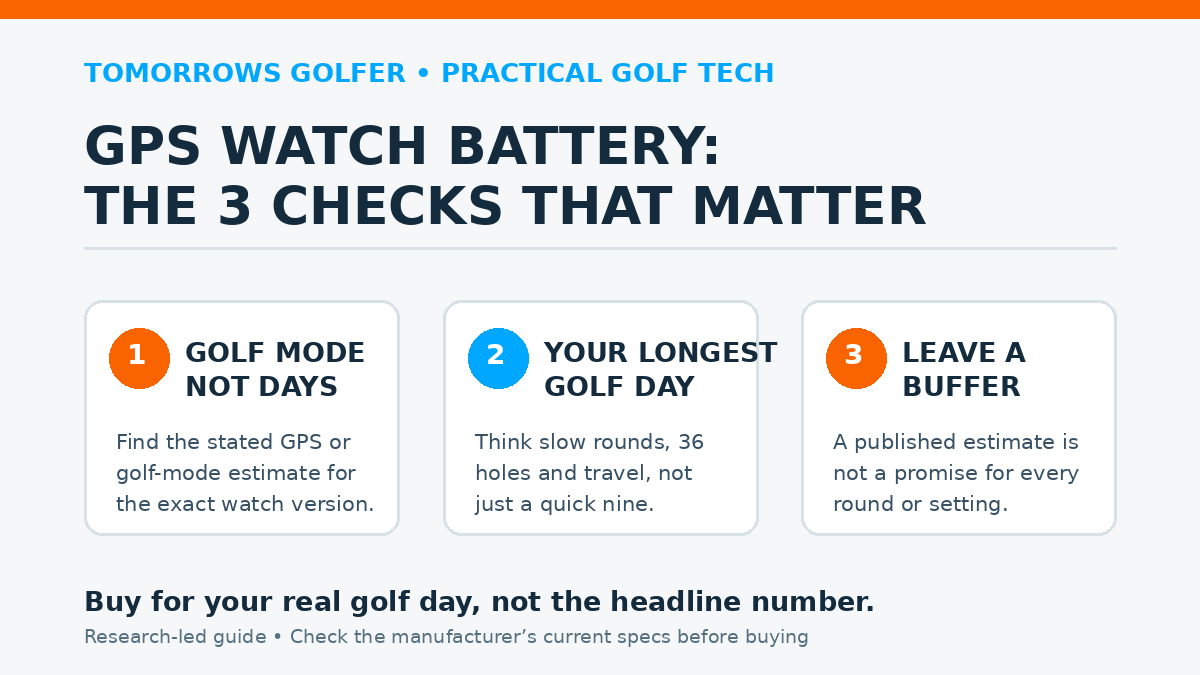
For golf, find the stated figure that is closest to continuous GPS use or the dedicated golf activity. Garmin, for example, publishes separate specifications for its Approach S70 and Approach S50. Check the specification page for the exact size and version you are considering rather than applying one model’s figure to another.
If a seller only shows a broad “battery life” claim, open the manufacturer’s specification page before buying. The answer you need may be in a footnote or a separate mode table.
Why one round can use more battery than another
A GPS golf watch is doing more than showing a clock. During a round it may be maintaining a location fix, drawing course information, lighting the display when you look at it and exchanging data with a phone or club-tracking accessory. The exact mix varies by watch and by the features you choose.
Three practical variables are worth keeping in mind:
- Screen behaviour: A brighter display, longer screen-on time and frequent map checks can demand more than brief glances at front, middle and back distances.
- Connected features: Phone notifications, score syncing and optional accessories may be useful, but they are not free from a battery point of view. Check the manual for your specific watch before assuming how a setting behaves.
- The shape of your day: A quick nine, a slow fourball, 18 holes followed by practice and a 36-hole day are different tests. Build in margin for the longest version of golf you actually play.
What “enough for a round” should mean
For a golfer who normally plays one 18-hole round and charges at home afterwards, a watch with a clearly stated golf-mode figure and a sensible buffer may be all that is needed. The decision changes if you regularly play long competition days, travel for weekends or do not want another device in the charging routine.
Use this simple check before you buy:
- Write down your longest realistic day: one round, a slow round, two rounds or golf plus travel.
- Find the exact model’s golf/GPS specification, including the case size and display version where relevant.
- Leave a buffer rather than shopping to the advertised limit.
- Check how and when the watch charges. A proprietary cable left at home can matter more than a small specification difference.
The same logic helps when comparing a watch with a phone app. A phone may have a bigger battery, but using it for GPS can compete with calls, travel, photos and other needs. Our guide to golf GPS watches versus phone apps covers the wider on-course trade-off.
How to make a GPS watch last more predictably
Start a round with a full charge when it matters. That sounds obvious, but it also removes uncertainty created by short top-ups and an ageing battery.
Then keep the settings practical. Use the golf screen you can read at a glance, rather than waking a detailed map every time you need a yardage. If you do not need notifications during a medal, consider reducing them. If your watch offers power-saving choices, read its official guidance first so you know which golf functions change.
There is no need to turn every feature off. The point is to choose the features that genuinely help your decision-making on the course. A watch that has enough charge for your full day and gives you distances quickly is more useful than one with a longer headline figure but an awkward golf workflow.
Battery age matters, but do not diagnose it from one bad day
Rechargeable batteries do not stay new forever, but a single unexpectedly short round is not enough evidence to blame battery health. Check for a software update, confirm the activity and display settings, and repeat the comparison across a few similar rounds. If the pattern persists, use the manufacturer’s support guidance for that model.
It is also worth separating a battery issue from course-data or GPS behaviour. If the distance itself looks wrong, see our guide to golf GPS watch accuracy. If you are still choosing a device, our UK golf GPS watch buying guide gives the broader category view.
Who this matters most to
Prioritise golf-mode battery information if: you play slow rounds, often play 36 holes, travel for golf, use a bright colour display, or want the watch to replace rather than back up your phone.
You can be less concerned if: you play occasional nine-hole rounds, routinely charge after golf and only want simple yardages.
The Tomorrows Golfer verdict
Do not compare golf GPS watches using a single “days of battery” number. Compare the stated golf or GPS mode for the exact version, then give yourself a generous margin for your longest normal day. A published figure is a condition-specific estimate, not a score for the whole watch. The best buying decision is the one that makes it unlikely you will need to manage the battery while trying to manage a score.
FAQs
Will a golf GPS watch normally last 18 holes?
Many are designed for golf use, but the reliable way to judge a particular model is its published golf or GPS-mode specification. Compare that figure with your expected round length and leave a buffer.
Does using GPS drain a golf watch faster?
GPS operation is a more demanding use case than simple timekeeping. Screen settings and connected features can also affect the practical result. Use the exact watch’s official documentation for its mode definitions.
Should I buy a watch with the biggest battery claim?
Not automatically. Battery is one part of the decision alongside readable distances, course features, comfort, charging routine and price. The important figure is the one that fits your own longest golf day.