Golf Simulator Flooring: What Should You Put Under a Hitting Mat?
Evidence: Research-led guide.
Short answer: for most home golf simulators, start with a stable hitting mat on a level, protected floor rather than trying to make the whole room feel like a driving range. The right flooring underneath depends on what you are protecting, how permanent the setup is and whether the mat stays put through a full swing.
This is a research-led guide, based on published mat and home-setup guidance rather than hands-on testing of every flooring option. It is for golfers planning a garage, spare-room or garden-room setup and trying to avoid an expensive, awkward mistake before buying a mat.
What your simulator floor needs to do
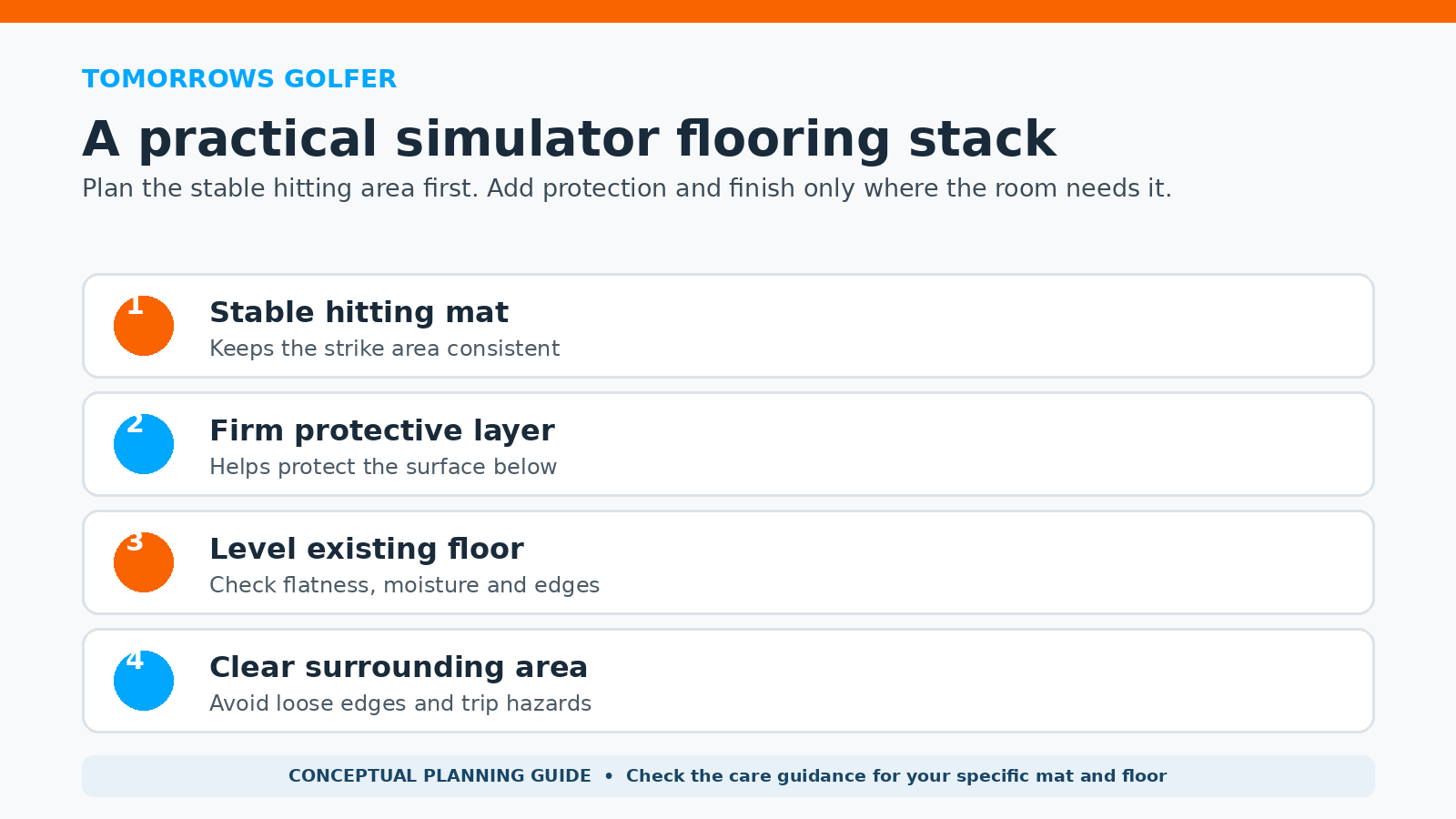
Flooring has four jobs: give the mat a stable base, protect the surface below it, reduce trip hazards and make the hitting area feel consistent enough to practise. It does not need to solve every problem in the room.
A thick, soft surface can feel comfortable underfoot but allow a mat to move or sink. A hard surface can be stable but may need a protective layer below the mat. The useful question is not “what is the best golf flooring?” but “what does this room need underneath this mat?”
Start with the base you already have
Concrete garage floor
Concrete is usually stable and simple to work with. The priority is protecting the mat and keeping it from creeping during use. Check for uneven patches, moisture and any raised edges before laying anything over it. A removable protective layer can make sense where you want to protect the concrete or soften the walk-in area, but it should not compromise the mat’s footing.
Carpeted spare room
Carpet can make a temporary setup feel less harsh, but it is not automatically a stable base. A heavy mat may compress it, and a raised edge can create a trip point. Check that the mat sits flat and that the hitting area does not rock when you address the ball.
Wood, laminate or vinyl
These floors benefit from a barrier that protects against rubbing, moisture and repeated movement. Avoid assuming a mat’s backing will protect every finish. Follow the flooring maker’s care guidance and do not use adhesives or fixings unless you are happy to make the setup permanent.
Choose the layer beneath the mat by purpose
Best for a simple, removable setup: a stable mat on a protected base
This suits golfers who want the room to remain useful for cars, storage or guests. Keep the stack low, make sure the mat lies flat and test whether it moves after a few full swings. It is the sensible default for a first simulator build.
The trade-off: it may not give the room a finished studio look, and the surrounding area can still feel hard or echoey.
Best for floor protection: a thin, firm barrier under the mat
A purpose-made protective layer or suitable underlay can help separate the mat from the finished floor. It should be firm enough that the mat remains level. Treat it as protection, not a substitute for a good hitting mat.
The trade-off: adding height can change your stance relative to the rest of the room. That matters more than it sounds if you are close to a low ceiling.
Best for a dedicated room: consistent surface around a fixed hitting area
A dedicated build can use matching floor covering around the mat to make the room easier to walk around and visually calmer. Plan cable routes, screen clearance and access to the computer before committing. The mat still needs to be stable and replaceable on its own terms.
The trade-off: a full-room finish costs more and is harder to alter if your simulator layout changes.
Do not ignore mat height and stance
A raised mat changes where your feet sit. If the ball is on a hitting strip or a different-height insert, the change can be more noticeable. Stand on the exact final stack, take practice swings and check your ceiling clearance before making flooring permanent.
This links directly to the wider room plan. Our guide to golf simulator room size explains why ceiling height and swing space come before finishing details. If you are deciding between a one-piece mat and a replaceable strike area, see golf hitting mat vs hitting strip.
Noise and vibration: be realistic
Soft layers can change the feel of footfall and may reduce some surface noise, but they are not a promise of soundproofing. Impact noise can travel through the mat, floor structure, walls and ceiling. For a flat or shared home, think about the full noise path before you buy more foam or flooring.
Keep the practical safety basics separate from acoustic ambition: clear the hitting area, keep loose edges taped or secured where appropriate, and do not run cables across walkways. If an electrical change or fixed installation is involved, use a qualified installer.
A practical buying checklist
- Measure the final height of the floor, underlay and mat together.
- Check the mat stays flat and does not slide during full swings.
- Protect a finished floor without creating a thick, unstable stack.
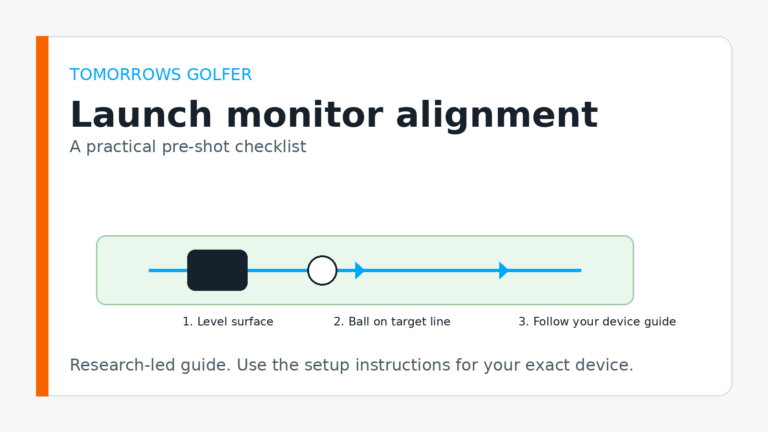
- Leave clear access around the hitting area and any launch monitor.
- Plan around your display choice, cables and room use before committing to a full-room finish.
- Confirm the mat maker’s installation and care guidance for the specific product.
Who this is for, and who should keep it simple
A protective base and a stable mat are enough for most golfers beginning with a garage or multi-use room. A whole-room flooring project makes more sense when the simulator is genuinely permanent and the rest of the layout is already proven.
Skip the full flooring project for now if you have not settled the hitting position, screen or net, display and launch-monitor placement. Start with a safe, removable base, then improve the room once you know you use it.
Tomorrows Golfer verdict
Do not buy simulator flooring as a cosmetic first step. Put the budget into a stable hitting area, safe clearance and a room layout that works. Flooring earns its place when it protects the space, keeps the mat secure and makes the setup easier to live with.
For the bigger budget picture, read what a home golf simulator really costs. For a screen or net decision, read golf simulator net vs impact screen.
Further checks
Before ordering, use the care and installation guidance supplied for the exact hitting mat and the existing floor in your room. Those documents are more useful than a generic compatibility list because backing, weight and surface requirements vary.