Golf Rangefinders with Slope: Can You Use One in Competition?
Evidence label: Research-led guide. This article is based on the current Rules of Golf and practical buying considerations. It is not a hands-on test of a particular rangefinder, and it is not a substitute for a competition’s terms or a referee’s ruling.
Short answer: a rangefinder that gives distance can be allowed in competition, but a slope-reading mode is not something to use during the round. The Rules of Golf allow distance or direction information, but they prohibit measuring elevation changes and using equipment that interprets that information into advice. Your competition can also use a Local Rule to ban distance-measuring devices altogether.
For an everyday golfer, the sensible approach is simple: check the event conditions, make sure any slope or elevation feature is genuinely disabled, and use the device only for permitted distance information. If you cannot confidently confirm the mode, leave it in the bag and ask the committee before play.
What the Rules of Golf actually allow
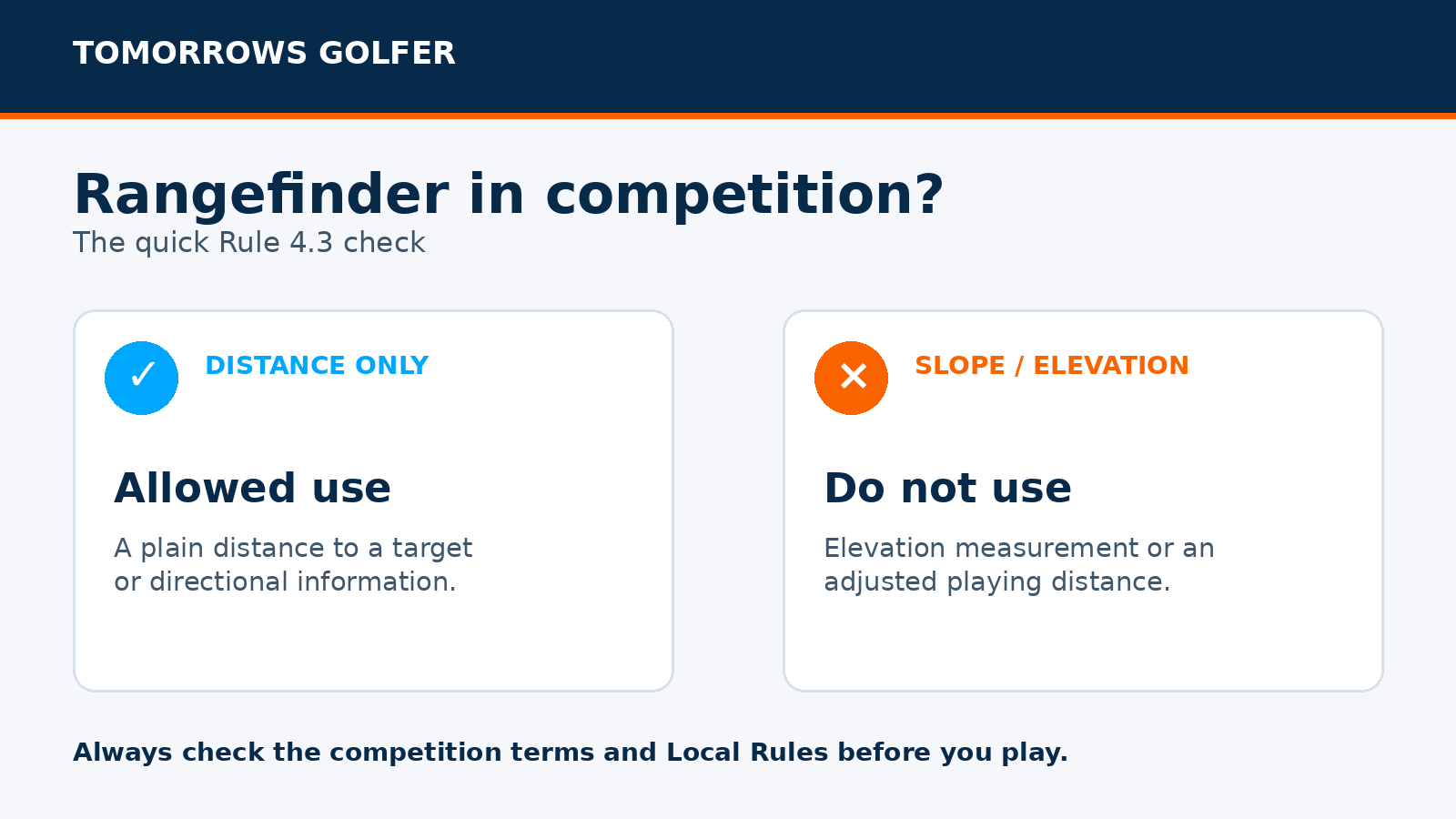
Rule 4.3 of the Rules of Golf deals with equipment used during a round. Under the section on distance and directional information, the R&A lists getting information on distance or direction from a distance-measuring device as an allowed use.
The same section says measuring elevation changes is not allowed. That is the important distinction for a rangefinder with slope. A slope function does more than tell you the straight-line distance to a flag or bunker. It uses elevation change to produce an adjusted number, which is not permitted while you are playing a competition round.
Read Rule 4.3 on the R&A website before a significant event, especially if you use a device with several modes. The official rule is the source to rely on, not a product listing or a setting you used in a casual game.
Is a slope switch enough?
Many rangefinders are designed with a slope mode that can be disabled for tournament use. That can be useful, but the presence of a switch, a light or a label is not itself a rules decision. You are responsible for how the equipment is used during the round.
Before you play, check these three things:
- What the device shows: use a distance-only mode. Do not use an adjusted distance based on elevation.
- Whether the setting is clear: make sure you can tell, without guesswork, which mode is active.
- What the competition says: a committee may adopt a Local Rule that prohibits distance-measuring devices, even when distance information would otherwise be allowed.
A rangefinder that is straightforward to operate is often the better competition choice than one with a long list of features you do not need. Convenience matters, but clarity matters more when a rules breach is the risk.
What else should you avoid?
Slope is the obvious feature, but it is not the only one worth checking. Rule 4.3 also draws a line around equipment that interprets distance or directional information to recommend a line of play or club selection. It also restricts using equipment to measure other conditions that affect play.
That does not mean every modern device is automatically unsuitable. It means you should look at the exact information you plan to use, the device’s active mode and the competition terms. If a feature goes beyond a plain distance to a visible target, pause and check it rather than assuming it is acceptable.
Rangefinder, GPS watch or both?
A laser rangefinder is best when you want a distance to a visible, specific target. A GPS watch is better when you want front, middle and back yardages, hazard distances or a wider view of the hole. Neither tool changes the need to understand the competition rules for the day.
Our GPS vs laser rangefinder guide explains that practical difference in more detail. If you already use a watch, also read our guide to using a GPS watch in competition. The same core principle applies: distance information may be allowed, while elevation, interpretation and event-specific restrictions need attention.
Who this is for
Choose a competition-friendly rangefinder if: you play medals, opens, league matches or other organised golf and want pin-specific distance without carrying a more complicated device.
Think twice if: you mainly play casual golf, enjoy using slope information and are unlikely to check the active mode before every competitive round. A simpler distance-only model may remove one decision, while a GPS watch may suit golfers who value hole context over a pin reading.
A practical pre-round checklist
- Read the competition terms and any Local Rules.
- Check whether distance-measuring devices are permitted for that event.
- Disable slope or elevation measurement before you tee off.
- Do not use any feature that gives adjusted distance, club advice or a recommended line of play.
- If the device mode is unclear, ask the committee or referee before starting.
Tomorrows Golfer verdict
A slope rangefinder is not automatically a problem to own. It is a problem to use in the wrong mode during a competition. If you want the least complicated route, buy or use a device that gives a clear distance-only reading and make the pre-round rules check part of your routine.
For a broader buyer’s view, see our guide to golf distance-measuring devices. It is a useful starting point for deciding whether a laser, GPS watch, handheld or combination of tools fits the way you actually play.