Can You Use a Golf GPS Watch in Competition? Rules, Features and What to Check
Evidence label: Research-led guide. This guide is based on the Rules of Golf and official guidance. It is not a hands-on test of a particular GPS watch, and it is not a substitute for the competition terms or a referee’s decision.
Short answer: a golf GPS watch is not automatically banned in competition. Whether you can use it, and which information or functions are allowed, depends on the Rules of Golf, any Local Rule in force and the terms of the event you are playing. A watch that can show yardages can also carry features that need to be disabled or avoided.
For a normal club competition, the practical job is simple: read the competition conditions before you tee off, put the device in the correct mode if it has one, and use it only for the permitted information. Do not rely on the words on the product box, a setting you used in a casual round or advice from a playing partner.
The practical answer: distance can be allowed, but check first
Rule 4.3 of the Rules of Golf covers the use of equipment during a round. The Rule allows a player to get information on distance or direction, such as from a distance-measuring device or compass. It also places limits on using equipment in ways that can replace a skill or judgement that is essential to the game.
That is why “my watch has GPS” is not a complete competition answer. The organiser may set a Local Rule or event condition that changes what is permitted for that competition. Your exact watch may also have several golf functions, some of which are useful in a casual round but need a closer look before a medal, league match or open.
Tomorrows Golfer verdict: if you only need a front, middle and back number, a GPS watch can be a calm and practical competition tool when the competition terms allow it. The moment you are unsure about a feature, turn it off, do not use it and ask the committee before play.
What the Rules say about equipment
The R&A’s Rule 4: The Player’s Equipment explains that the rule concerns how equipment is used, not simply what a player has in their bag. In the Rule 4.3 section, getting distance or direction information is listed as an allowed use.
The same Rule draws a line around equipment that interprets distance or direction to give a recommended line of play or club selection based on the location of the ball. It also restricts measuring or gauging other conditions that affect play. That distinction matters more than the name of the device on your wrist.
The R&A also publishes Model Local Rules. Those are useful reading for competition organisers and golfers because Local Rules are part of the practical framework around a specific event. Treat the competition notice, entry terms and starter’s instructions as the current source for your round.
Three checks to make before you play
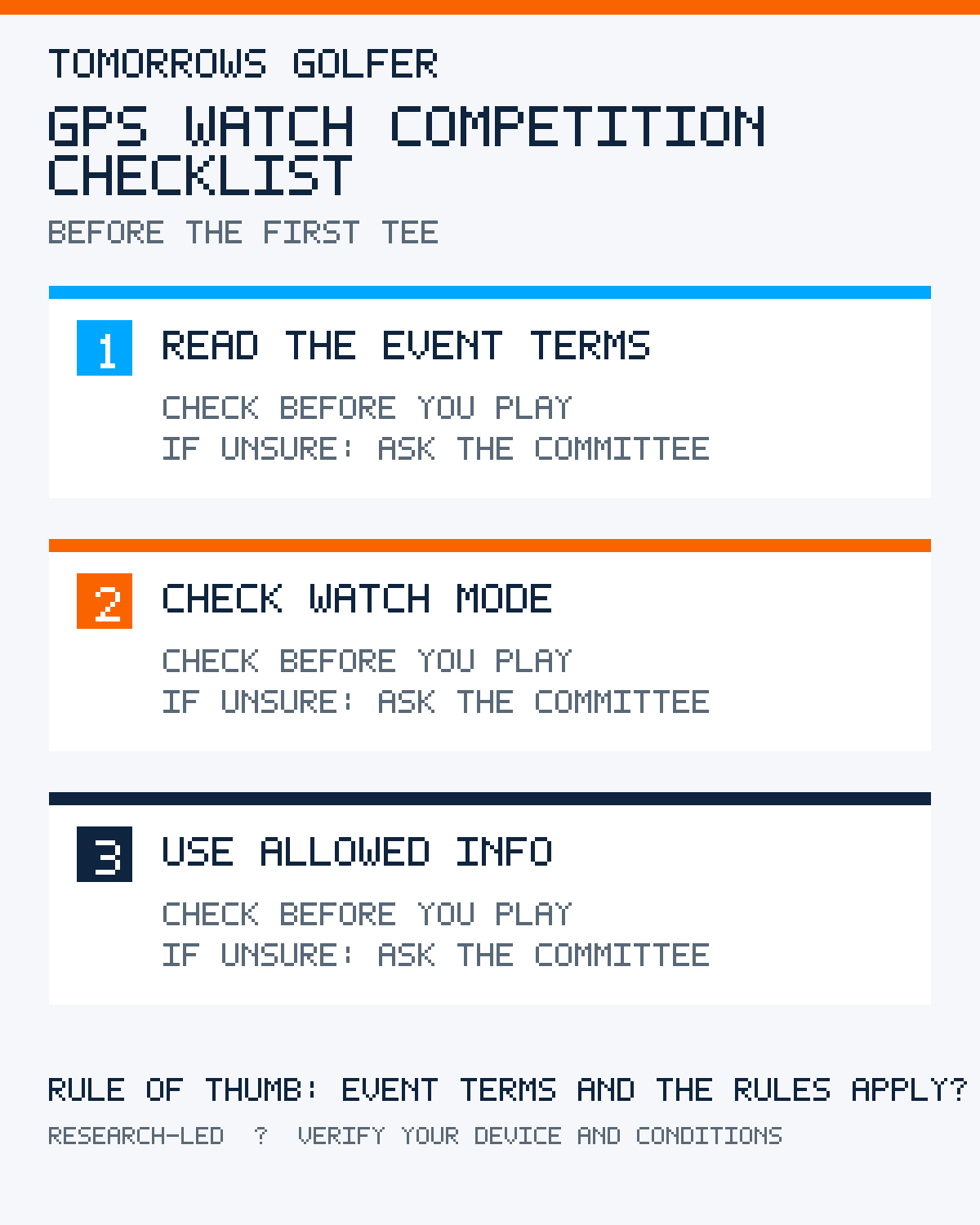
1. Read the competition terms, not a general internet answer
Start with the noticeboard, online entry page, competition WhatsApp or the club professional’s guidance. Look for any wording on distance-measuring devices, mobile phones, scoring apps or electronic equipment. A club may use a Local Rule, and an away open may use a different condition from your home competition.
If the wording is unclear, ask the committee before you start. A quick question on the first tee is much easier than trying to reconstruct a setting or a conversation after a score has been returned.
2. Check the exact mode on the exact watch
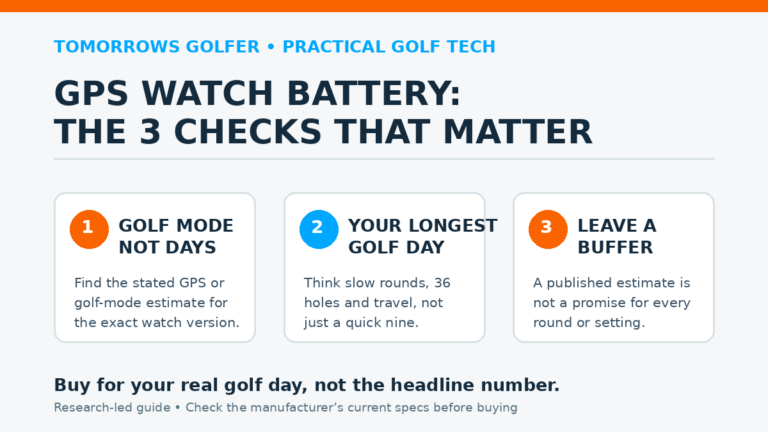
Many golf watches and apps have a tournament, competition or distance-only setting. That can be helpful, but the label alone is not proof that the device is compliant for every event. Manufacturers can change features through firmware updates, and menu labels do not override the Rules or the competition conditions.
Open the official manual or support page for your exact model and check what the selected mode actually removes. Do this at home rather than in the car park. Take a screenshot of the setting if the device makes it easy, then check it again before the round.
3. Decide what information you will use
Keep your competition workflow narrow. If the event allows distance measurement, use the straightforward number you need and put the watch away. Do not drift into experimenting with advice, analysis or environmental information because the screen happens to offer it.
This is also a good pace-of-play habit. A watch is at its best when it gives a quick, useful distance rather than becoming a tiny second-guessing machine on every shot.
Features that deserve an extra check
Feature names differ between brands, so do not use this as a model-by-model compatibility list. Instead, use it as a prompt to inspect your device and the competition terms.
Elevation, slope or plays-like distance
Some devices can adjust a distance using elevation or show a distance that is intended to reflect how a shot may play. That is not the same thing as a simple distance to the front, middle or back of the green. Check whether the function is present, whether it can be disabled and what the event permits. If you cannot establish that clearly, do not use that feature.
Club recommendations and shot advice
A watch or linked app may offer club suggestions, strategy prompts or a recommended line of play. Rule 4.3 specifically highlights interpreting distance or directional information to get a recommended line of play or club selection as an issue. Do not assume that a feature is acceptable merely because it is common in a consumer golf product.
Weather and environmental information
Golfers often see wind, weather or other conditions on a phone or watch. The Rules make distinctions about how equipment is used to measure or gauge conditions affecting play. Competition conditions can also matter. A safe routine is to separate normal weather awareness from a device function that measures or evaluates a condition for you, then ask the committee if you are unsure.
Shot tracking, swing analysis and statistics
Logging a score or reviewing your own round may feel harmless, but the details matter. A feature that records information for later review is different from one that offers real-time advice or an analysis intended to influence the next shot. Read the current guidance for the product and event rather than assuming every data feature falls on the same side of the line.
A safe GPS-watch competition routine
- The night before: charge the watch and read the competition terms.
- At home: check the official manual for your exact model, then select the relevant competition or distance-only mode if applicable.
- Before the first tee: confirm the selected mode and make sure any questionable feature is off or unavailable.
- During the round: use only the information the event permits. Keep it simple.
- If something changes: stop using the feature and ask the committee or referee. Do not guess because you have used it in a social round.
Watch, phone app or laser in competition?
The competition question is about permitted use, not just the hardware. A GPS watch can be fast and discreet. A phone app can show a larger map but may bring more functions and more opportunities to select the wrong setting. A laser can give a direct distance to a visible target, but it also needs to be used within the competition conditions.
If you are choosing a device rather than checking one you already own, start with the decision you need on the course. Our guide to golf GPS watches versus phone apps explains the everyday trade-offs, while GPS versus a laser rangefinder looks at the different information each tool provides. For a broader purchase decision, see our guide to golf distance-measuring devices.
Who this guide is for, and who should skip it
This guide is for: golfers who own or are considering a GPS watch and want a practical pre-competition checklist. It is especially useful if you play club medals, league matches, opens or away fixtures where the local terms may differ.
Skip this guide if: you need an instant ruling on a situation that has already happened. Speak to the competition committee, referee or governing body. A published guide cannot determine the facts of your particular round.
Bottom line
A GPS watch can be a sensible competition companion, but only when you use it within the Rules and the conditions of that event. Keep the information simple, confirm the settings before you start and ask when a feature is unclear. That approach protects your scorecard and lets the technology do its useful job without becoming another source of doubt.