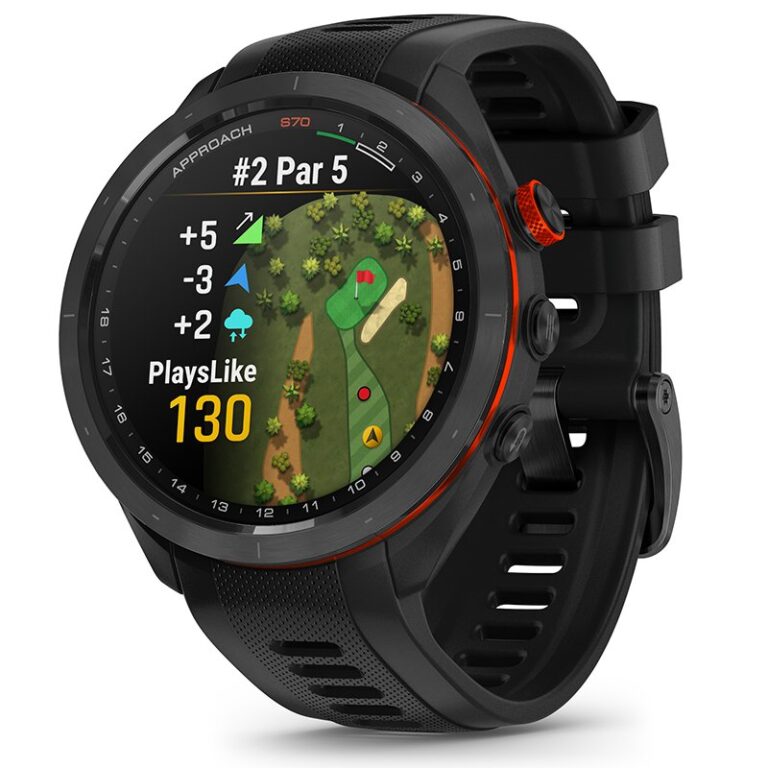
Golf GPS Watch vs Phone App: Which Is Better for Golf?
Evidence label: Research-led guide. This article is based on product documentation, app information and practical on-course considerations. It is not a hands-on test of a particular watch or app.
A golf GPS watch and a phone app can both get you a front, middle and back number. The better choice is usually not about raw distance accuracy. It is about which device you will actually use quickly and calmly when the rain starts, the group behind is waiting and your phone is also trying to be your scorecard, camera and normal life.
For most regular UK golfers, a dedicated GPS watch is the simpler on-course tool. A phone app is the stronger value option if you are happy carrying your phone, have a reliable battery plan and want richer maps or stats without buying another device.
The short answer
Choose a golf GPS watch if: you want the least friction between walking up to a ball and choosing a club. A watch is always on you, keeps your phone in the bag and is usually the calmer choice in wet or busy rounds.
Choose a phone app if: budget matters most, you value a larger map and are willing to manage a phone, its battery and notifications. It can be an excellent first GPS setup, particularly for occasional golf or unfamiliar courses.
Use both if: you already own a smartwatch or GPS watch but want a bigger map or post-round analysis on your phone. The watch can handle the quick on-course number while the app does the heavier work before and after the round.
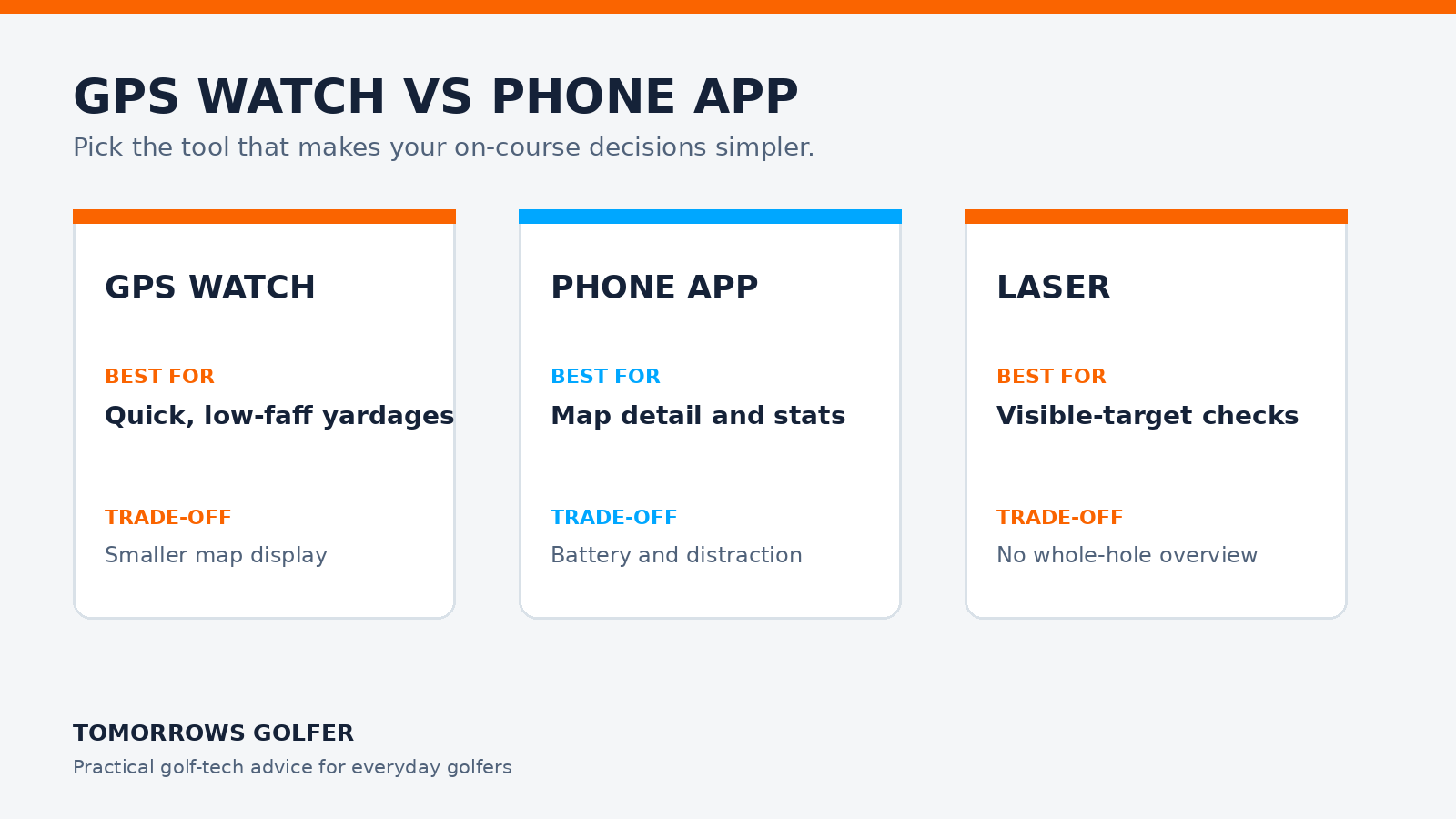
Golf GPS watch vs phone app: the decision table
Dedicated golf GPS watch
Best for: regular golfers who want a glanceable distance without reaching into a pocket or bag.
The trade-off: a smaller display and an upfront hardware cost. Course-map features and detailed green views vary by device, so check the official course and feature information before buying.
Golf GPS phone app
Best for: golfers who want a large map, scoring and stats features in one place, or who want to try GPS without committing to another device.
The trade-off: more handling, more battery anxiety and more potential distraction. Some useful features may sit behind an optional subscription, so treat the free version as a trial of the workflow rather than proof that the full feature set is free.
Laser rangefinder
Best for: golfers who want a precise distance to a visible target, especially a flag, tree or bunker edge.
The trade-off: it cannot show the shape of an unfamiliar hole, carry distances to hidden trouble or a whole-hole plan. It complements GPS rather than replacing it.
1. Speed of use: the watch usually wins
Speed is the strongest argument for a watch. The screen is already on your wrist, so the question becomes a glance rather than a sequence: find phone, unlock it, open the app, wait for position and put it away again.
That difference matters more than it sounds. On a familiar hole, you may only need a middle-of-green number before selecting a club. A watch makes that a low-interruption habit. It also leaves your hands free for a trolley, umbrella or scorecard.
A phone app can be perfectly quick when it is already mounted on a trolley, kept in an accessible pocket or used by a player who enjoys studying the hole. It loses ground when it lives at the bottom of a golf bag or when you are trying to protect it from weather.
2. Weather: neither is magic, but the watch is less awkward
UK golf means wet grips, drizzle and the occasional round that starts dry and finishes very differently. A watch avoids the repeated act of taking a glass-screen phone out into that environment. That is a usability advantage, not a claim that every watch is waterproof or that every phone will fail.
Check the water-resistance rating and care guidance for the exact watch and phone you own. A touchscreen can also be less pleasant with wet fingers, even when the phone itself is weather-resistant. Physical buttons can be useful on a watch, but the controls differ by model.
If you prefer a phone app, a weatherproof pocket, a trolley mount with a cover and a small microfibre cloth are practical improvements. The important point is to plan for the conditions you actually play in, rather than the conditions in a product photo.
3. Battery: think about the whole round, not the headline figure
GPS uses power. A watch needs enough charge for GPS use across your normal round, while a phone is simultaneously dealing with screen brightness, mobile signal, maps, notifications and possibly music or scoring.
In practice, phone battery management is often the bigger concern because the device has other jobs after golf. A round that leaves you with a nearly flat phone is inconvenient if you need directions, a lift or a call home.
Before relying on any setup in a competition or a remote course, run it through a full round. For a phone, start well charged, take a compact power bank if needed and avoid assuming an app will work identically with poor reception. For a watch, charge it before the round and check the manufacturer’s stated GPS-battery mode for your exact device.
4. Maps and course availability: the phone has the larger canvas
A phone’s main advantage is visual context. A larger screen makes it easier to see bunker shapes, lay-up areas and the route around a dogleg. Apps can also combine GPS, scoring, shot tracking and statistics in one place.
For example, the Hole19 official site describes its app as a GPS rangefinder and scorecard with course discovery and performance features. Its current offering is a useful reminder to check what a particular app does in its free tier and what is reserved for a paid plan.
A watch still offers map and hazard information on many devices, but the display is necessarily smaller. The right question is not whether a watch has a map. It is whether you can read and act on that map comfortably at your pace of play.
Whatever you choose, look up your home club and the courses you plan to play before purchase. Official manufacturer and app course databases are more useful evidence than a generic claim that a platform covers “every” course. A missing or poorly mapped course is a bad surprise to discover on the first tee.
5. Subscriptions and ongoing costs: read the feature boundary
A watch tends to concentrate cost at the start: buy the device, then use its included golf features subject to that manufacturer’s terms. A phone app can look cheaper because the entry point may be free, but advanced maps, statistics, club recommendations or other extras may require a recurring plan.
Neither model is automatically better value. The useful comparison is three seasons of use:
- How much will the watch cost you to buy and keep charged?
- What does the app’s feature set cost if you use the paid tier you actually want?
- Will you keep using the detail, or do you mainly need yardages?
Do not choose on a headline price alone. Read current official plan information at the point of purchase and compare features like course maps, statistics and offline use, rather than assuming all apps or watches work the same way.
6. Notifications and distraction: this is a real buying factor
A phone brings work messages, group chats, news and social apps to the course. For some golfers, that is harmless. For others, it turns a quick yardage check into two minutes of screen time and a broken pre-shot routine.
A watch can also show notifications, so it is not automatically distraction-free. The difference is control. A dedicated golf watch can be used as a narrowly focused distance tool, while a phone needs a deliberate setup: turn on Do Not Disturb, silence non-essential alerts and decide whether you are scoring in the app or simply using GPS.
If you regularly lose concentration after looking at a phone, do not dismiss that as a minor preference. It is a strong reason to favour a watch or use a laser plus a simple scorecard.
7. Display size: bigger is useful, but not always better
A phone wins outright for map detail, score-entry comfort and reviewing a hole before you play it. That is why it can be particularly useful on a new course or when planning from the tee.
A watch wins for “enough information now”. Front, middle and back distances are legible at a glance on a suitable screen, and that often leads to faster, simpler decisions. More detail is only an advantage when you will use it without slowing yourself or the group down.
The same trade-off appears in our wider guide to golf distance measuring devices: the best tool depends on the question you need answered, not the longest list of features.
Where a laser fits
A laser is best viewed as a specialist companion. GPS gives a strategic picture: distance to the front and back, hazards, lay-up zones and the middle of the green. A laser gives a direct distance to something you can see.
That makes a watch-plus-laser combination sensible for golfers who want quick strategic numbers and a precise flag check on approach shots. It can also be overkill for a golfer who mainly wants a reliable middle-of-green number and simpler rounds.
Before using any distance-measuring device in a competition, check the competition’s local rule and the Rules of Golf. Features that measure slope or other conditions may not be permitted when a distance-only device is allowed. Our GPS vs laser rangefinder guide explains the broader choice in more detail.
Who a GPS watch is for
- Golfers who play regularly and want less phone handling during a round.
- Players who value a quick middle-of-green number over a detailed aerial map.
- Anyone who plays through changeable weather and wants their phone protected in the bag.
- Golfers who are easily distracted by phone notifications.
Who should skip a GPS watch
- Occasional golfers who would rather spend nothing extra and are comfortable using their phone.
- Players who want a large, interactive map and detailed scoring or stats as their main on-course tool.
- Anyone expecting every watch to offer the same maps, green detail, battery behaviour or subscription model.
The Tomorrows Golfer verdict
For a golfer who wants the least faff during a normal Saturday round, a dedicated golf GPS watch is usually better. It is quicker to check, keeps the phone out of the weather and makes it easier to stay in your routine.
A phone app is still the value choice when you want richer maps and do not mind managing your device. It makes particular sense before buying a watch, because it lets you learn whether you genuinely use GPS information beyond a front, middle and back distance.
Choose the watch for friction-free yardages. Choose the app for map detail and lower upfront cost. Add a laser only if you regularly need a line-of-sight number to a visible target. For help narrowing down the hardware side, see our guide to the best golf GPS watches.